
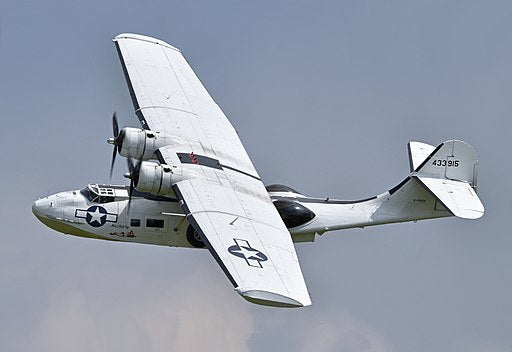
The Rise and Development of the PBY Catalina
The iconic and multifaceted aircraft of World War II, PBY Catalina, was manufactured by Consolidated Aircraft Company during World War II’s 1930s period of rapid technological progress in aviation technology. Isaac M. Laddon led its design concept, focused on providing an extended operational range with significant payload capacities.
One of the PBY Catalina’s distinctive qualities was its amphibious capabilities, enabling it to operate on water and land. The Catalina was easily distinguished among its contemporaries due to its parasol wing design and dual hull configuration. Recognizable among them for their versatile nature, used extensively in search and rescue missions, patrol bombing missions, antisubmarine warfare operations, and convoy protection roles with outstanding performances each time out.
PBY Catalina in Wartime
The Catalina, officially known as the Consolidated PBY Catalina, demonstrated its adaptability and endurance during the challenging circumstances of World War II. It was renowned for its capacity to undertake extended missions over significant periods, frequently lasting several hours. The Catalina’s long-range reconnaissance capabilities made it an indispensable asset for the Allied forces, often leading to the discovery and neutralization of enemy ships.
Catalina earned further notoriety by participating in several notable events, such as spotting the Japanese fleet at the Battle of Midway, marking a turning point for Pacific theater war efforts. She participated in the war and was instrumental in aiding the Allies’ victory.
The Catalina was designed with endurance in mind, initially intended as a long-range patrol bomber capable of disrupting enemy supply lines. It was equipped with two 14-cylinder Twin Wasp Radial Piston R-1830-92 Engines capable of producing 1200 bhp each, contributing to its long operational range.

Own a Piece of the PBY Catalina
What does “PBY” mean in Catalina?
Now let’s untangle what lies behind ‘PBY’; these three letters were selected by the U.S. Navy pre-1962 aircraft designation system, and each letter represents a particular meaning: P stands for Patrol while B stands for Bomber; these were both secondary roles in the Catalina was designed to fulfill and finally, ‘Y’ stands for Consolidated Aircraft which provides its design code.
Thus, “PBY” represents more than simply random letters; it represents a coded description of its function and creator. Not limited solely to Catalina aircraft in U.S. military aviation, this naming convention was applied widely across different aircraft classes.
The PBY Catalina stands as an iconic representation of military aviation with its distinct design and multidimensional roles, having seen service during World War II operations and serving an essential function as part of wartime operations – it even bears its designation ‘PBY’! It serves as an effective encapsulation of both the purpose and origin of this remarkable aircraft.












Share:
The Distinction Between the Bf 109 and the Me 109
The B-1 Bomber: A High-Speed Heavyweight