
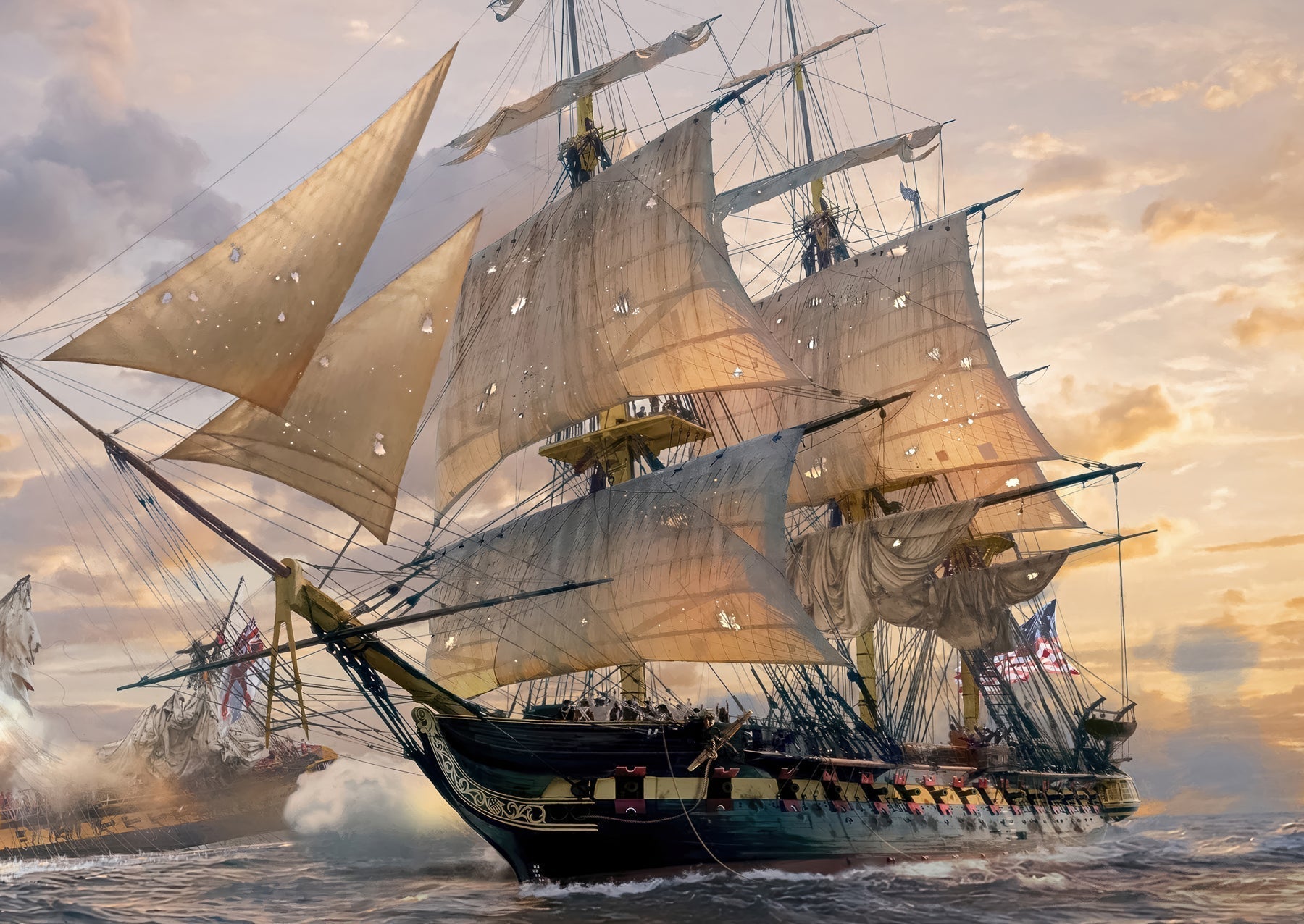
19 August 1812 - USS Constitution met HMS Guerriere in open battle off Nova Scotia. At the time, the Royal Navy dominated the seas, and British Captain James Dacre reportedly predicted he would defeat the American frigate within forty-five minutes. Instead, within half an hour of the engagement, Guerriere was dismasted, shattered, and forced to strike her colors.

USS Constitution - Boston Harbor - 2013 Photo From the Artist
Captain Isaac Hull had prepared carefully for this moment. During this period in 1812, Constitution carried a yellow-ochre stripe along her gun deck — not the familiar white band seen in most modern depictions and restorations. Hull intentionally altered her appearance to resemble a British warship, drawing the enemy closer before revealing her true identity. When the broadsides began, American gunnery proved decisive. British casualties numbered 101 out of 302 men, while Constitution suffered only 14 casualties among her crew of 456.
The battle’s impact reached far beyond the Atlantic. News of the victory electrified the young United States, proving that its Navy could defeat a ship of the world’s foremost maritime power. It was during this engagement that British shot was said to have glanced from Constitution’s heavy oak hull — earning her the enduring nickname, “Old Ironsides.”
Research Behind the Artwork
The Final Broadside captures the climactic moment as Constitution delivers the decisive salvo, the explosion erupting near Guerriere’s foremast. Particular care was taken to depict the historically accurate yellow-ochre gun stripe of 1812 rather than the later white scheme more commonly shown in popular art.

"USS Constitution vs HMS Guerriere" 1812 - Michele Felice Cornè
The composition draws heavily from contemporary eyewitness accounts and from the series of paintings created by 19th-century artist Michele Felice Cornè. Cornè’s works were commissioned directly by Captain Isaac Hull to commemorate the victory, making them among the most reliable visual references from the period. Those early depictions, combined with archival research and firsthand study aboard the ship herself, guided the proportions, rigging, sail configuration, and battle positioning in this piece.
A Living Connection
Included with this artwork is an original oak fragment removed during the 1973–1974 Bicentennial restoration of USS Constitution. That restoration prepared the ship for her commemorative sailing and ensured her continued preservation as the oldest commissioned warship afloat.
 USS Constitution - Boston Harbor - 2025 Photo From the Artist
To hold a fragment of her oak is to hold material from one of the earliest guardians of American sovereignty — a warship authorized in 1794, forged in the uncertain years of the young republic. As the nation commemorates its 250th anniversary, this relic connects directly to that formative era, offering not just a piece of wood, but a preserved element of the country’s early flex of strength — entrusted now to the next steward of its history.
To purchase or see similar items, visit here.
Commissioned by Museums, Treasured by Collectors


Share: