
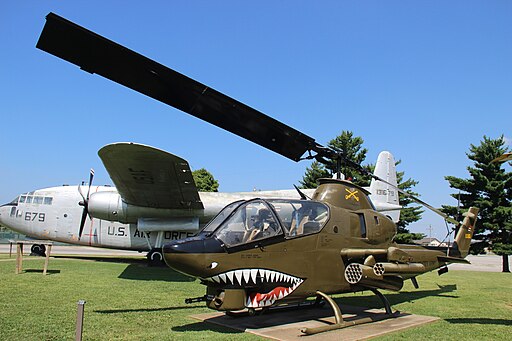
Combat helicopters? Two names instantly jump to mind: the AH-64 Apache and the AH-1 Cobra. These aren’t just any helicopters; they’re beasts that have been flexing their muscles for the U.S. military for many years. Each of these machines brings something unique to the table, boasting its own set of standout strengths. But there’s this perpetual debate – which one is better?
Firepower
Mainly used by the U.S. Army, the AH-64 Apache is no lightweight. It’s armed with a heavy-duty 30mm M230 chain gun and can carry a whopping 16 AGM-114 Hellfire missiles or 76 Hydra 70 rockets. It could even tote a mix of the two if needed. And trust me, these missiles and rockets aren’t just for show. They are incredibly powerful and are good at taking out things like armored vehicles and enemy strongholds.
The AH-1 Cobra, the pride and joy of the U.S. Marine Corps, comes with its own set of impressive features. This includes a robust 20mm M197 Gatling cannon with three barrels and an ability to load up on a mix of AGM-114 Hellfire missiles and Hydra 70 rockets, not forgetting the TOW missiles. That said, it needs to catch up to the Apache a bit when it comes to carrying capacity. Speaking strictly in terms of raw firepower, the Apache has an upper hand thanks to its superior carrying capacity and the additional punch packed by its 30mm chain gun.
Maneuverability
The AH-1 Cobra, being lighter and having a sleeker design than the Apache, has the edge regarding speed and agility. It can zip through the sky at speeds of up to 227 mph. Its slimmer build makes it a more challenging target to hit and allows it to squeeze through tight spots easily. On the other hand, the Apache might not be as nimble, but it can still hold its own. Thanks to a top-notch navigation system and a state-of-the-art rotor design, it can maneuver with pinpoint accuracy, even when the weather is throwing a tantrum.
 Own a Piece of a Cobra Helicopter
Survivability
The Apache was designed with survivability in mind. It features crash-resistant seats for the crew and is equipped with robust armor that protects vital areas against up to 23mm rounds. Additionally, it possesses self-sealing fuel systems to minimize the risk of fire. While not as heavily armored as the Apache, the Cobra has an advantage in its smaller profile, making it a more difficult target to hit.
Technological Systems
The Apache leads in this aspect, equipped with some of the most advanced technology. The Longbow radar system allows the Apache to detect, classify, and prioritize over 100 targets. Additionally, it has integrated night-vision systems and a helmet-mounted display, among other advanced systems. While the Cobra does have night vision capabilities and advanced targeting systems, they are not as advanced as those of the Apache.
Determining the “better” helicopter depends mainly on the specific mission requirements. The AH-1 Cobra’s speed, agility, and smaller profile make it perfect for situations requiring quick response and maneuverability. In contrast, the AH-64 Apache’s firepower, survivability, and advanced technological systems make it ideal for complex battle scenarios with heavy enemy engagement.
It’s crucial to remember that both the Apache and the Cobra are superb machines designed for different tactical environments. They have proven their mettle in countless operations and continue to be cornerstones of U.S. military aviation.














Share:
What was the Most Feared Tank in World War II?
What were Spitfires used for?