
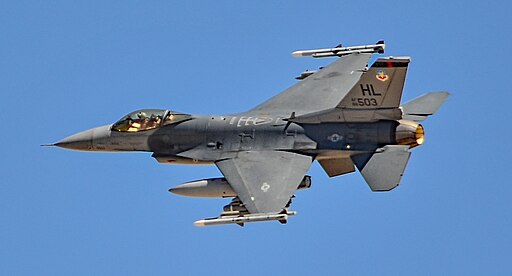
We’ve journeyed far since the Wright Brothers’ maiden flight, landing today in an era of advanced fighter jets with mind-blowing capabilities. Amidst this, the F-16 Fighting Falcon has etched its unique presence. So, what sets this marvel apart? Let’s explore the unique attributes and capabilities that have put the F-16 in a league of its own.
A Design Ahead of Its Time
When it first took to the skies, the F-16 represented a fresh dawn in fighter aircraft design. Its most notable feature was the pioneering relaxed static stability/fly-by-wire (RSS/FBW) flight control system. This revolutionary system blends agility with stability, endowing the aircraft with remarkable maneuverability.
Several other features also helped the F-16 break the mold. It showcased a frameless bubble canopy for unparalleled visibility, a side-mounted control stick for easier maneuvering, and a reclined seat to mitigate the impact of g-forces on the pilot – all innovative for their era.
Power and Flexibility
The F-16 is a testament to power and flexibility. As a multi-role fighter jet, it can undertake many missions, from air-to-air and air-to-surface combat to enemy air defense suppression and aerial reconnaissance.
The F-16’s formidable engine, coupled with its lightweight design, allows it to surpass twice the speed of sound and ascend beyond 50,000 feet. The jet is also known for its ability to execute 9g turns, outflanking many of its counterparts.

Own a Piece of an F-16
Evolving with Time and Technology
The F-16’s true appeal lies in its enduring relevance and adaptability. Since its inception in the 1970s, the F-16 has seen a series of upgrades to keep pace with the evolving demands of modern warfare. These enhancements span improved radar systems, precision weaponry, advanced electronic systems, and engine technology.
The F-16 has remained a staple in the air forces of over 25 nations, despite being in service for several decades. Despite emerging, more sophisticated threats, continuous upgrades ensure it remains a formidable adversary.
The Last Word
The F-16 Fighting Falcon is far more than an impressive fighter jet. It’s a symbol of the evolution of aviation and a tribute to human innovation. Its groundbreaking design, impressive performance, adaptability, and enduring presence are what make it truly extraordinary. It is a shining example of how sustained enhancements and adaptability can ensure an aircraft’s relevance and potency, even many decades after its inaugural flight.
In the rapidly evolving realm of aviation, the F-16 stands as evidence that true excellence can weather the sands of time. It’s not just special—it’s in a class all its own.












Share:
Could the Messerschmitt Me 262 have won the war? An Examination of World War II’s First Jet Fighter
Did pilots like the P-40?