
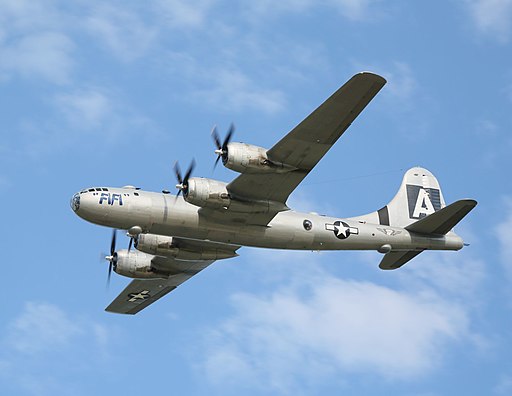
The Boeing B-29 Superfortress was among the most technologically ambitious aircraft of World War II. Designed for very long-range strategic bombing, it combined pressurized crew compartments, remotely controlled defensive gun turrets and powerful engines in an aircraft capable of reaching targets far beyond the range of earlier American bombers.
A Bomber Built Around Range
Development began before the United States entered the war. The B-29 was larger, faster and more complex than the B-17 and B-24, but that sophistication created serious development problems—particularly with the Wright R-3350 engines.
Pressurized crew areas allowed crews to operate at high altitude without wearing oxygen masks continuously. A tunnel connected the forward and aft pressurized compartments across the unpressurized bomb bays.
From China to the Marianas
Early B-29 operations against Japan were flown from bases in China, requiring an enormous logistical effort to move fuel and supplies across the Himalayas. The capture of the Mariana Islands provided much more practical bases at Saipan, Tinian and Guam.
From the Marianas, B-29s conducted the strategic bombing campaign against Japan, including large incendiary raids against urban-industrial areas. Modified B-29s also carried the atomic bombs dropped on Hiroshima and Nagasaki in August 1945.
The Superfortress continued into the Korean War, but its World War II service established the model for the long-range, high-technology strategic bombers that followed.

Share: