
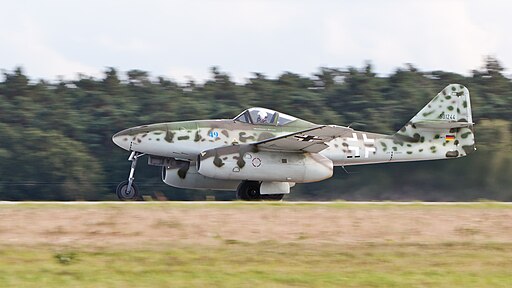
The Messerschmitt Me 262 was the world's first operational jet fighter and substantially faster than the piston-engine fighters it encountered. That performance has fueled decades of speculation about whether earlier or larger-scale deployment could have changed the outcome of World War II.
What the Me 262 Did Well
Powered by two Junkers Jumo 004 turbojets, the Me 262 had a major speed advantage over Allied fighters. Four 30 mm MK 108 cannon gave it devastating firepower against heavy bombers.
In combat, Allied pilots often found the jet difficult to catch once it accelerated. They adapted by attacking Me 262s during takeoff and landing, when the jets were slow and vulnerable, and by targeting their airfields.
The Limits Were Larger Than the Aircraft
The Me 262's engines had short service lives and depended on materials that were increasingly scarce in wartime Germany. Fuel shortages, disrupted transportation, Allied bombing, pilot-training losses and collapsing industrial capacity all limited operations.
Producing more jets would also have required diverting resources from other urgent programs. Even a technically superior fighter still needed trained pilots, fuel, spare engines, maintained airfields and an intact logistics system.
A Powerful Fighter in a Losing Strategic Position
Earlier deployment could have increased Allied bomber losses and complicated the air campaign. But Germany faced overwhelming Allied advantages in industrial production, fuel, trained manpower and forces advancing on multiple fronts.
The Me 262 was an important technological development and a dangerous combat aircraft. Its limitations as a potential war-changing weapon came less from its speed than from the strategic situation in which it entered service.
Share: