
Invaders Across the Channel depicts Adolf Galland and his wingman flying Messerschmitt Bf 109Es toward England during the Battle of Britain. In 1940, Galland emerged as one of the Luftwaffe's most successful fighter pilots while serving with Jagdgeschwader 26, a unit heavily engaged against RAF Fighter Command over southern England and the English Channel.
The Bf 109 Relic
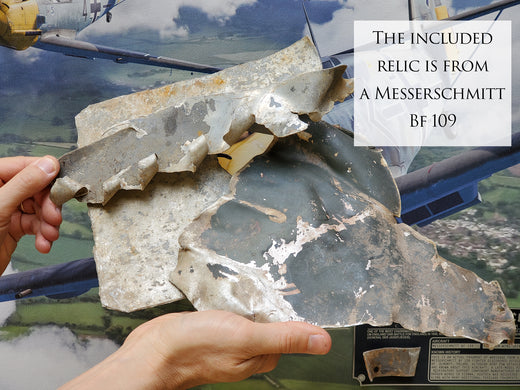
The relic associated with the artwork is a Messerschmitt Bf 109 wing-skin fragment discovered near Olmonty, Poland. Few details are known about the individual aircraft. A later-model pilot respiratory component manufactured by Dräger-Werke in Vienna was reportedly recovered with numerous fuselage fragments, but no identifying data plate or Werknummer has been documented that would allow the wreckage to be tied to a specific pilot or loss.

Messerschmitt Bf 109 relic fragments associated with the artwork.
Galland and the Battle of Britain
Galland entered the Battle of Britain as an experienced combat pilot and became Gruppenkommandeur of III./JG 26 in June 1940. Flying the Bf 109E, he accumulated victories rapidly during the fighting over the Channel and southern England. In August he took command of JG 26, and by the end of 1940 he had become one of Germany's best-known fighter aces.

Adolf Galland's Messerschmitt Bf 109E-4, W.Nr. 5819, photographed in France in 1940.
The Bf 109E was the Luftwaffe's principal single-engine fighter during the campaign. Its performance made it a formidable opponent for RAF Hurricanes and Spitfires, but operations over Britain imposed an important limitation: the Bf 109's relatively short endurance left pilots with little time over targets before they had to turn back across the Channel.

Galland's Bf 109E-4 photographed at Le Touquet in April 1941.
From Fighter Pilot to General der Jagdflieger
Galland's influence extended beyond his combat record. In November 1941 he was appointed General der Jagdflieger, placing him in a senior leadership role overseeing the Luftwaffe's fighter arm. He continued to press for stronger fighter defenses and the development and deployment of advanced aircraft, including the Messerschmitt Me 262 jet fighter.
His relationship with Luftwaffe leadership became increasingly contentious as Germany's air situation deteriorated. Galland was removed from his position in early 1945 following disputes over fighter strategy. He later returned to combat as part of Jagdverband 44, a unit equipped with the Me 262 during the final months of the war.

Another view of Galland's Bf 109E-4 during his service with JG 26.
Invaders Across the Channel focuses on the earlier period of Galland's career, when the Bf 109E and the pilots of JG 26 were engaged in the Luftwaffe's attempt to gain air superiority over Britain.


Share: