
James “Jabby” Jabara became the first American pilot credited as a jet ace during the Korean War. Flying the North American F-86 Sabre against MiG-15s, he helped define a new era of aerial combat in which opposing jet fighters met at speeds and altitudes far beyond those of the previous war.
The F-86A Relic
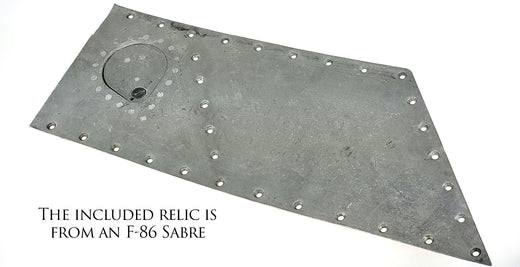
The relic associated with the artwork comes from an aluminum access panel from an F-86A Sabre wing. The panel provided access to the drop-tank system and retains the wording “DROP TANK FUEL & PRESSURE DRAINS” along with part number 172 14711 61.

F-86A Sabre aluminum access panel associated with America's First Jet Ace.

Detail of the F-86A access panel and its original markings.
Jabara in Korea
Jabara had already flown combat missions during the Second World War before transitioning to jets. In Korea, he flew the F-86 against MiG-15s in the air battles that became closely associated with “MiG Alley” near the Chinese border.
On 20 May 1951, Jabara's credited victory total reached five MiG-15s, making him the first American jet ace. He later returned to Korea for another combat tour and increased his total to 15 credited aerial victories, making him a triple ace.
America's First Jet Ace commemorates that transition from propeller-driven combat to the jet age while the surviving F-86A panel provides a direct material connection to the Sabre itself.

Share: