
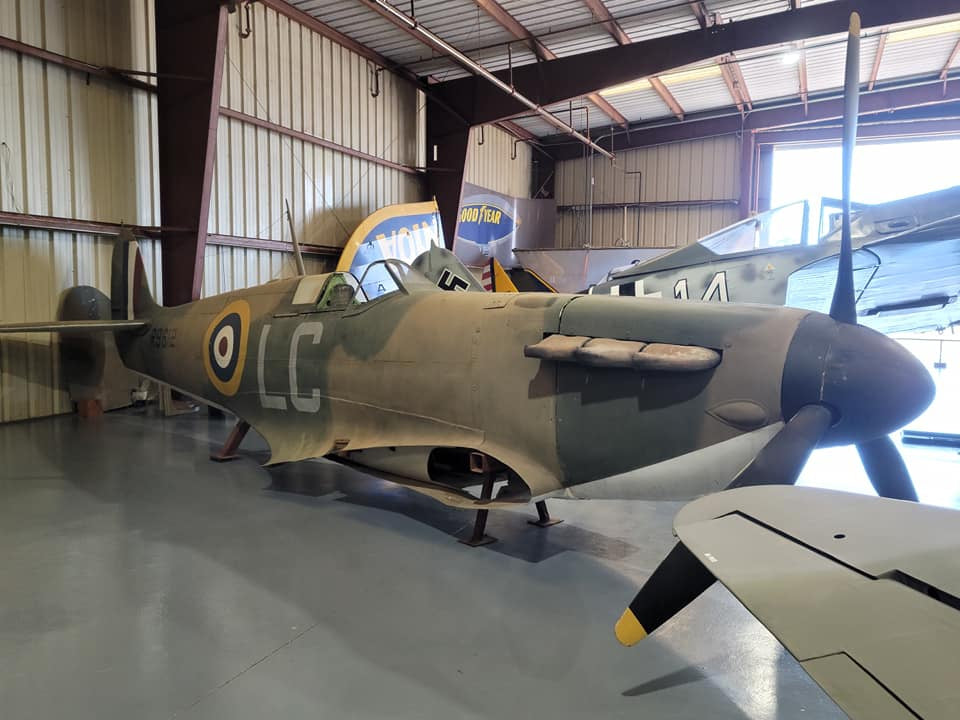
At first glance, it looked like another Spitfire. Then something about the tail gave it away.
During a visit to the Imperial War Museum Duxford, I came across what appeared to be a Supermarine Spitfire, but a closer look showed that the horizontal stabilizer and elevator were molded together rather than built as separate working flight surfaces. The reason: this was not a flyable aircraft at all, but a full-scale movie prop created for Dunkirk.

The full-scale Spitfire prop from Dunkirk at IWM Duxford.

The tail was one of the clues: the stabilizer and elevator were molded together in fiberglass.
Built for the Water, Not the Air
The prop was constructed for scenes requiring a Spitfire on the water. A film production needs an aircraft that looks convincing on camera, but it does not necessarily need the structure, controls or systems of an airworthy fighter. Details such as the fused tail surfaces reveal the very different engineering priorities behind a movie prop.
That contrast makes the aircraft particularly interesting when viewed in a museum filled with genuine historic airplanes. From a distance the silhouette does its job; up close, the construction begins to tell the story of how filmmakers created the illusion.

A closer view of the Spitfire prop built for the water sequences in Dunkirk.
For me, discovering what it actually was made the find more interesting, not less. It was an unexpected intersection of aviation history, aircraft construction and filmmaking—and exactly the sort of detail that makes wandering through Duxford worthwhile.
Share: